Warm Minimal in a Singapore Flat: Matching Solid Wood Furniture the Right Way
Warm minimal is one of the harder interior languages to speak fluently in a Singapore HDB. You want rooms that breathe, but the average 4-room flat in Tampines or Punggol gives you roughly 90 sqm of usable space, a 90 cm-wide corridor, and a service lift that swallows only pieces up to about 210 cm tall when tipped. Bring in the wrong dining table and you will bruise the door frame during delivery. Bring in the wrong bed frame and your bedroom turns into a sauna because the wardrobe blocks the window cross-breeze. The furniture has to work twice as hard as the square footage suggests, and that is where solid wood quietly outperforms everything else.
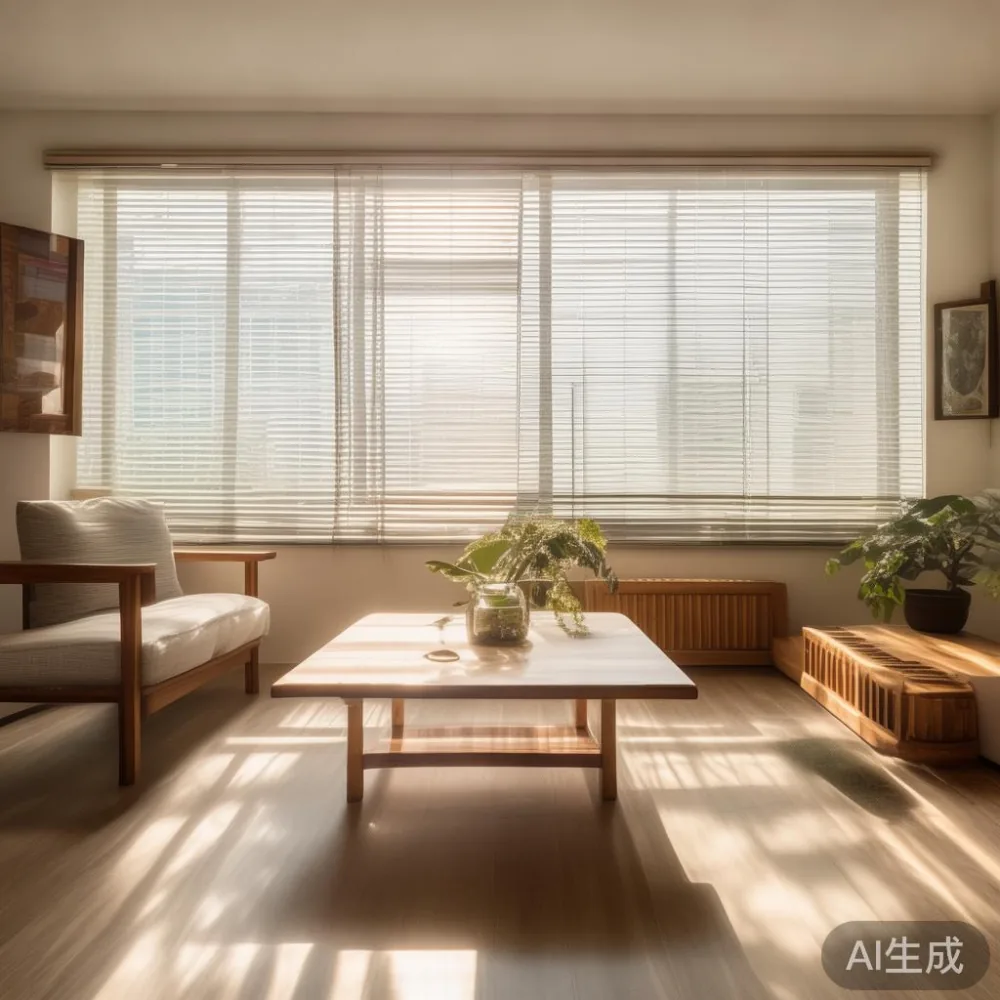
Last month I visited a 5-room BTO in Bedok with a couple who had spent nine weekends hunting for a sofa, a dining table, and a bed frame that all "spoke the same language." They owned two pieces from a Scandinavian chain and one from a Taobao bulk store. The wood tones clashed, the legs were different heights, and the room felt smaller than it actually was. After two hours, we swapped everything for pieces from one collection — a solid wood sofa in light oak, a 1.6 m dining table in the same grain, and a low-profile bed frame — and the same flat suddenly read as a calm, warm minimal interior. The lesson was not about spending more. It was about choosing pieces that share a material and a proportion.
What "warm minimal" actually means in a HDB context
Warm minimal is not the stark, gallery-white minimalism you see in European show flats. It borrows the clean lines and the discipline of negative space, then warms them up with natural materials — most often solid wood, linen, boucle, travertine, and brushed brass. The palette sits between ivory, sand, oat, and a muted caramel. Black is used as punctuation, not as the base tone. In a humid Singapore flat, this matters: dark-heavy minimalism absorbs heat visually and physically, while warm minimal reads cool and breathable even when the room is 30°C.
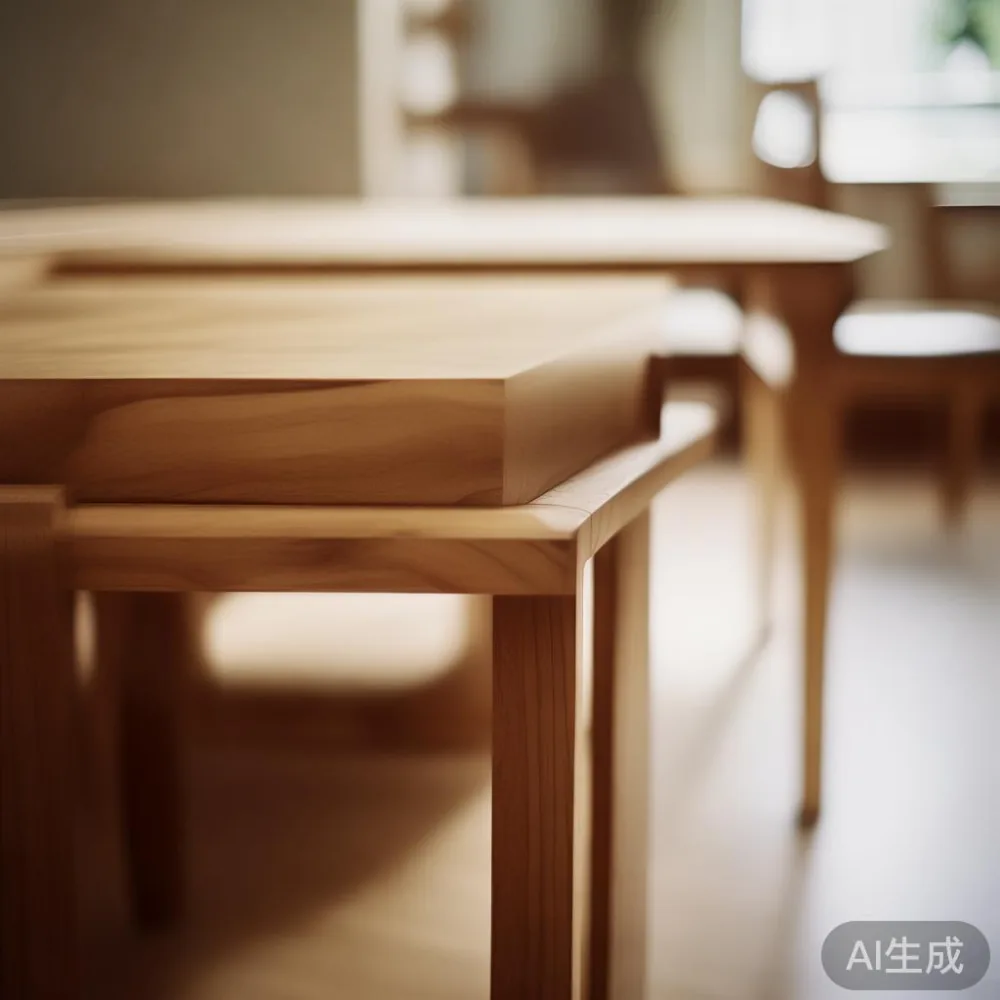
For a 3-room HDB around 65 sqm, I usually recommend three anchoring pieces and nothing more: a dining table for four, a two-seater sofa, and a bed frame. A separate TV console is optional if the living wall already has built-in cabinetry. Adding more than four large pieces into a flat this size will crowd the corridors and eat into the 90 cm clearance that the fire code and your sanity both need.
What wood species and tones read as "warm minimal" without going orange?
Not every brown is a warm brown. In the swatches I keep on my desk, only four wood tones consistently land the look in Singapore light:
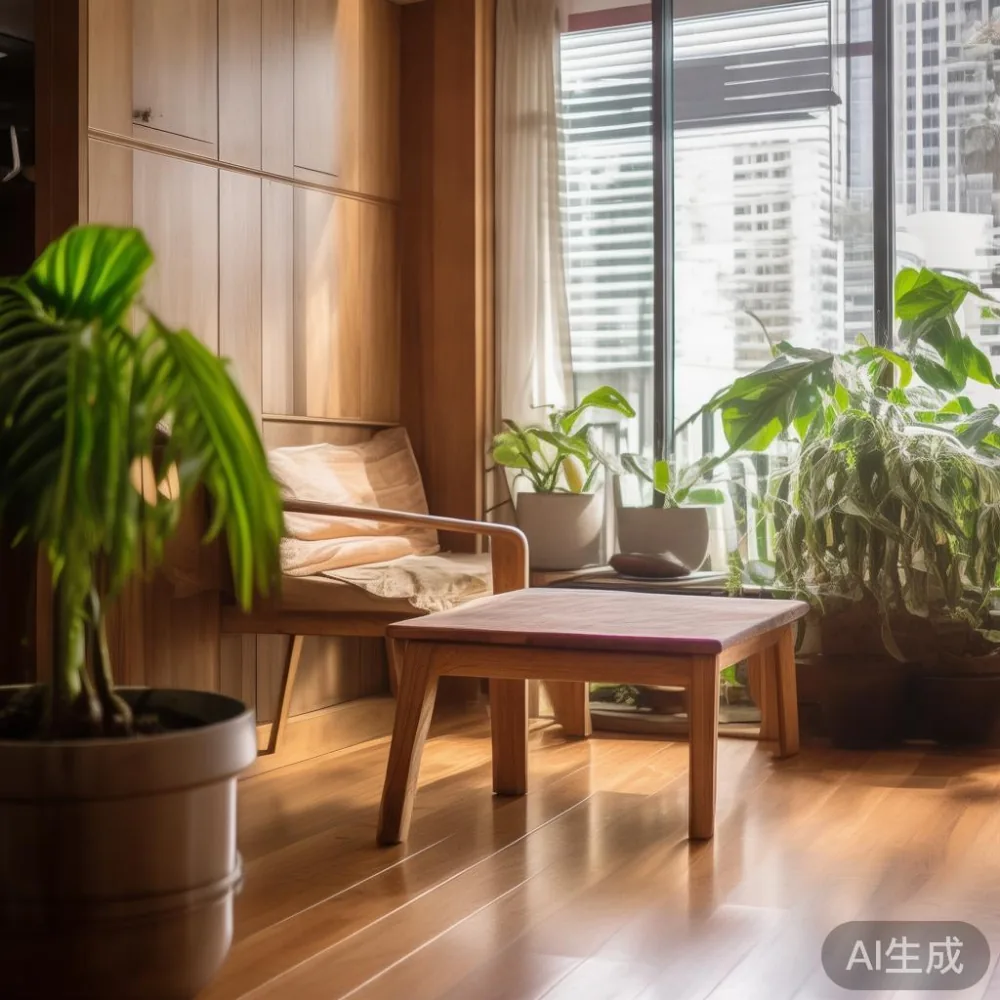
- Natural white oak — pale honey, neutral undertone. The safest choice for resale flats with grey-beige floor tiles.
- Light ash — slightly cooler than oak, with grey-green streaks. Pairs well with a boucle sofa.
- Natural walnut — warm chocolate without red. Best in rooms with at least 2.5 m ceiling height because it visually drops the room.
- Honey teak — the classic local tone, works in conservation shophouse-style condos in Tiong Bahru but can overpower a 2.7 m HDB ceiling.
Avoid dark-stained rubberwood and the orange-red meranti that ships in many flat-pack sets. They age into a muddy maroon under our equatorial UV, and they fight every other material in the room. When in doubt, ask for the FSC certificate and the moisture content reading — anything between 8 and 12 percent is safe for our climate, and anything above 15 percent will cup or twist within six months.
How do I choose a solid wood sofa that does not swallow my living room?
This is the question I get most often from homeowners in Punggol and Sengkang, where the living room runs about 3.2 m wide. The short answer: a three-seater solid wood sofa in this category usually measures between 200 cm and 220 cm long, 88 cm to 95 cm deep, and 78 cm to 85 cm tall. If your TV wall is shorter than the sofa, the room looks top-heavy. If the sofa is more than 220 cm long, you lose the 70 cm walking lane to the dining zone.
Two practical checks before you click pay:
- Measure your lift door. Standard HDB passenger lifts are about 80 cm wide and 140 cm deep; service lifts run 110 cm by 210 cm. A sofa deeper than 95 cm will not fit through a passenger lift without a tilt-and-squeeze that often scratches the linen. Confirm with the seller in writing.
- Check the leg height. Anything under 8 cm looks like a slab on the floor and traps dust. Anything above 15 cm starts to look like a 1980s coffee-shop seat. The sweet spot for warm minimal is 12 cm to 14 cm.
You will see many "oak sofa" listings at SGD 1,200 to SGD 1,800 in Singapore. Most are veneer over plywood with a 3 mm oak face. A genuine solid wood sofa, where the frame, the armrest, and the legs are all one piece of timber, starts around SGD 2,400 and runs past SGD 4,800 for a 2.4 m three-seater in full-grain leather. The price jump buys you a frame that can be re-glued, re-strung, and re-upholstered in 10 to 15 years rather than thrown away.
Dining tables, marble tables, and the corridor problem
The standard HDB dining zone in a 4-room flat is roughly 2.4 m by 1.6 m. That gives you just enough room for a 1.4 m table, but most couples I work with want to seat six during Chinese New Year. The math gets tight. A 1.6 m marble table seats six comfortably, but marble weighs between 75 kg and 110 kg for that size — and the service lift in older blocks in Bedok and Toa Payoh has a 1,000 kg payload limit that gets shared with your neighbours moving in on the same weekend.
Two ways around it. The first is a sintered stone top on a solid wood base, which drops the weight to around 45 kg and still looks like marble from two metres away. The second is a 1.4 m solid wood dining table that extends to 1.8 m with a hidden leaf. For a warm minimal interior, I usually steer people toward the extendable option because the everyday footprint stays small.
If you want a separate marble table for the entryway — a common request in new Pinnacle@Duxton units — keep the dimensions under 80 cm by 35 cm. Anything larger blocks the corridor and the fire-escape signage. Stick to a beige or soft-veined white marble; the dramatic Calacatta styles look tired within a year and clash with most warm minimal palettes.
Bed frames and wardrobes: why proportion matters more than size
A king-size bed frame measures about 180 cm by 200 cm. Add a 60 cm nightstand on each side and a 60 cm deep wardrobe on the opposite wall, and a 3.2 m wide bedroom is suddenly full. The trick in a warm minimal bedroom is to lower the visual height of the bed frame. A platform bed at 28 cm to 35 cm from the floor will make the ceiling feel taller and the room feel wider. Headboards above 110 cm will do the opposite.
For a typical HDB master bedroom in a 5-room flat, the combination I recommend is a solid wood platform bed frame in queen size, two slim nightstands at 45 cm wide, and a floor-to-ceiling wardrobe in the same wood species. If the wardrobe runs along the window wall, leave a 15 cm gap from the ceiling so air can circulate; otherwise you trap humidity and the wardrobe doors will cup within two monsoon seasons.
One piece that often gets overlooked is the bedside reading light. In warm minimal bedrooms, skip the table-lamp-plus-nightstand combo and mount a swing-arm sconce into the wall. It saves 25 cm of nightstand space, which is enough room for a book, a glass of water, and a phone — and nothing more.
Nightstand, wardrobe, and the small-room rule of three
For a warm minimal bedroom under 12 sqm, follow the rule of three: one bed frame, two nightstands, one wardrobe. Anything beyond that — a dresser, a bench, a console — should be replaced with double-duty pieces. A nightstand with a USB-C drawer, a wardrobe with a built-in dressing mirror, a bed frame with two shallow under-drawers. Each of these removes one piece from the room without removing one function.
Dimensions I use as a baseline:
- Nightstand: 45 cm wide, 38 cm deep, 55 cm tall. Wider than 50 cm and you cannot open the wardrobe door behind it.
- Wardrobe depth: 55 cm to 60 cm. Anything shallower and hangers swing diagonally.
- Wardrobe height: 240 cm max for HDB ceilings. Going taller blocks the air-con return vent and the wardrobe will lean over time.
Will a solid wood wardrobe survive a Singapore bedroom without warping?
Yes, if you pick the right construction. The two failure modes I see most often are: (1) doors cupping within 18 months because the wardrobe was built with panels thinner than 18 mm, and (2) the carcass bowing because the back panel was 9 mm MDF instead of solid timber. For our humidity, ask for 20 mm or 25 mm side panels, a solid back panel at 12 mm minimum, and door panels that are framed — not slab — so the centre panel can float inside a groove and expand without splitting.
A well-built solid wood wardrobe in white oak for a 2.4 m wide wall runs SGD 3,200 to SGD 5,800 depending on internal configuration. Add SGD 600 to SGD 900 for soft-close hinges, a pull-out trouser rack, and felt-lined jewellery drawers. Installation usually takes one day for a two-person crew and adds about SGD 250 to the bill. Disposal of your old wardrobe, if the building management requires a contractor, is another SGD 150 to SGD 220.
How does light luxury positioning change the furniture choice?
The phrase "light luxury" gets used loosely in Singapore, but it usually means post-modern light luxury: recognisable silhouettes from the 1970s softened with contemporary proportions, mixed with American light luxury references like channel-tufted headboards and slim brushed-brass legs. The trick is to keep the silhouettes clean and the materials honest. A solid wood bed frame with a low channel-tufted headboard reads as light luxury without tipping into theme-park French provincial.
If you are weighing European sofa vs French provincial sofa, the difference comes down to silhouette. European silhouettes (think B&B Italia, Minotti) sit low, deep, and lean on long lines. French provincial sits higher, with curved arms, cabriole legs, and decorative trim. In a 3 m wide HDB living room, a European silhouette will make the room feel wider; a French provincial silhouette will make it feel like a guesthouse in Provence — charming, but tighter. Most of my clients in their early 30s in Punggol are choosing the European silhouette for everyday use and saving French provincial for a future landed property.
Where does a single-source brand simplify all of this?
This is the practical reason I usually point clients toward a single workshop rather than mixing three retailers. When the bed frame, dining table, nightstand, and wardrobe come from the same maker, the wood is from the same batch, the finish is the same hand-rubbed oil, and the leg heights line up within 2 mm. Midhill is one of the workshops I have specified on recent projects because their pieces hold the same timber tone across the dining, bedroom, and living zones, and their wardrobe construction is built for our humidity. Their bed frames also pair cleanly with a boucle or linen headboard if you want to soften the look without losing the solid wood frame.
The bigger reason for one-source buying is after-sales. A solid wood dining table that develops a hairline crack in month 14 is very different from a chipboard table that delaminates in the same month. The first is a 30-minute repair; the second is a bin trip. Midhill's lifetime refinishing offer is one of the few in the local market that actually ships the piece back to the Foshan workshop for a full re-sand and re-oil, which matters if you want the same table for the next 20 years.
What about budget ranges for a full warm-minimal set in SGD?
For a 4-room HDB, a full warm-minimal furniture package — solid wood sofa, dining table for four, queen bed frame, two nightstands, and a 2.4 m wardrobe — typically lands between SGD 9,500 and SGD 18,000 depending on timber and upholstery. The cheaper end uses ash or white oak from faster-growth forests. The upper end uses slower-growth walnut and full-grain leather. Mid-century modern for bedroom cues (low platform, tapered legs, no headboard or a slim one) usually save about SGD 800 to SGD 1,200 over a fully upholstered bed.
For shoppers comparing options under 2000 Japanese furniture retail, the same set usually costs SGD 7,000 to SGD 10,500 in that category — but most pieces are MDF with a thin wood veneer, and the after-sales network in Singapore is thin. If you are browsing under 2000 European light luxury furniture, expect the frame to be solid but the panels to be veneer, and the lead time from European warehouses to a Singapore door to run 8 to 14 weeks plus GST (currently 9 percent) and a SGD 350 to SGD 800 freight bill.
How to style a Japandi sofa in a small bedroom without losing floor space
Japandi is the easiest style to misuse in a HDB because the look depends on negative space. The trick is to pick a Japandi sofa or daybed that is at least 12 cm shorter than your wall width, then leave 60 cm of clear floor on at least one side. In a 2.8 m wide bedroom, that means a sofa no longer than 160 cm. If you are working out how to style a Japandi sofa in bedroom, anchor one corner with a 40 cm solid wood side table and a paper lantern-style floor lamp; skip the throw pillows, keep one linen throw folded along the back, and let the wood do the talking.
Delivery, GST, and the Singapore-specific checklist
Before you confirm any order, run through this list:
- Lift dimensions, in writing from your MCST or HDB branch.
- Corridor width on every floor the piece travels through, including the turn at the lift lobby.
- Total weight, because the service lift payload is shared.
- GST line item (9 percent) and whether the price includes or excludes it.
- Lead time in calendar days, not business days. Add seven days for festive seasons.
- Disassembly option if the piece is 5 cm too wide. Most solid wood dining tables can split into top and base.
- Warranty terms: structural, finishing, and hardware. A 10-year structural warranty is the floor, anything less is a red flag.
- Returns: 14 days is the standard in Singapore. Anything that requires you to pay return shipping on a 90 kg table is worth a closer look.
A short note on the bed frame you keep seeing online
Across the Instagram feeds my clients share with me, one solid wood bed keeps appearing in the warm-minimal category: a low oak platform with a slightly curved headboard and tapered legs, often called out in searches for the best French provincial bed for 2026 even though its silhouette is more Scandi than provincial. It pairs with most boucle headboard cushions, fits a queen mattress at 152 cm by 188 cm, and survives the trip up a HDB service lift without drama. If you want a single piece to anchor the bedroom, that profile is hard to beat.
Frequently asked questions from Singapore homeowners
How long does delivery take from a Foshan workshop to a Singapore HDB door? Sea freight from Shenzhen or Hong Kong to Singapore runs 7 to 12 days, plus 3 to 5 days for customs clearance and last-mile delivery. Door-to-door, expect 14 to 21 days for in-stock pieces and 35 to 55 days for custom orders. Local warehouses in Jurong or MacPherson can sometimes deliver in 3 to 5 working days if you are willing to pick from a smaller colour range.
Can a 2.4 m wardrobe fit through a HDB service lift? Most service lifts in newer BTOs measure 1.1 m wide by 2.1 m deep, which fits a flat-packed wardrobe but rarely a fully assembled one. Order the wardrobe in two carcasses (1.2 m + 1.2 m) and assemble in the bedroom. The installer will need about 4 hours and a drill.
Is solid wood worth the price difference over veneer? For pieces you use daily — a bed frame, a dining table, a wardrobe — yes. The frame can be repaired rather than replaced, the patina improves over 10 to 15 years, and the resale value holds. For pieces you might change in five years — a side table, a console — veneer is the rational pick.
What is the lifespan of a solid wood dining table in Singapore? With a re-oil every 18 to 24 months and protection from direct afternoon sun, 25 to 40 years is realistic. I have clients in Tiong Bahru still using the same teak table they bought in 2003.