Veneer vs Solid Wood in Singapore: What Really Costs Less Over Five Years?
Six months ago, a colleague in Punggol invited me over to help her settle a furniture dispute. She had bought a 1.6m dining table for S$899 from a Jurong East showroom and a near-identical-looking solid wood dining table from a Foshan maker for S$1,850. Five years apart, the veneer table was peeling along the edge where her son does homework; the solid wood piece had a coffee-ring stain and nothing else. That afternoon, scribbling on the back of an NTUC receipt, is what pushed me to write this piece properly: a five-year cost comparison that Singapore households can actually use, with corridor widths, lift sizes, and GST all factored in.
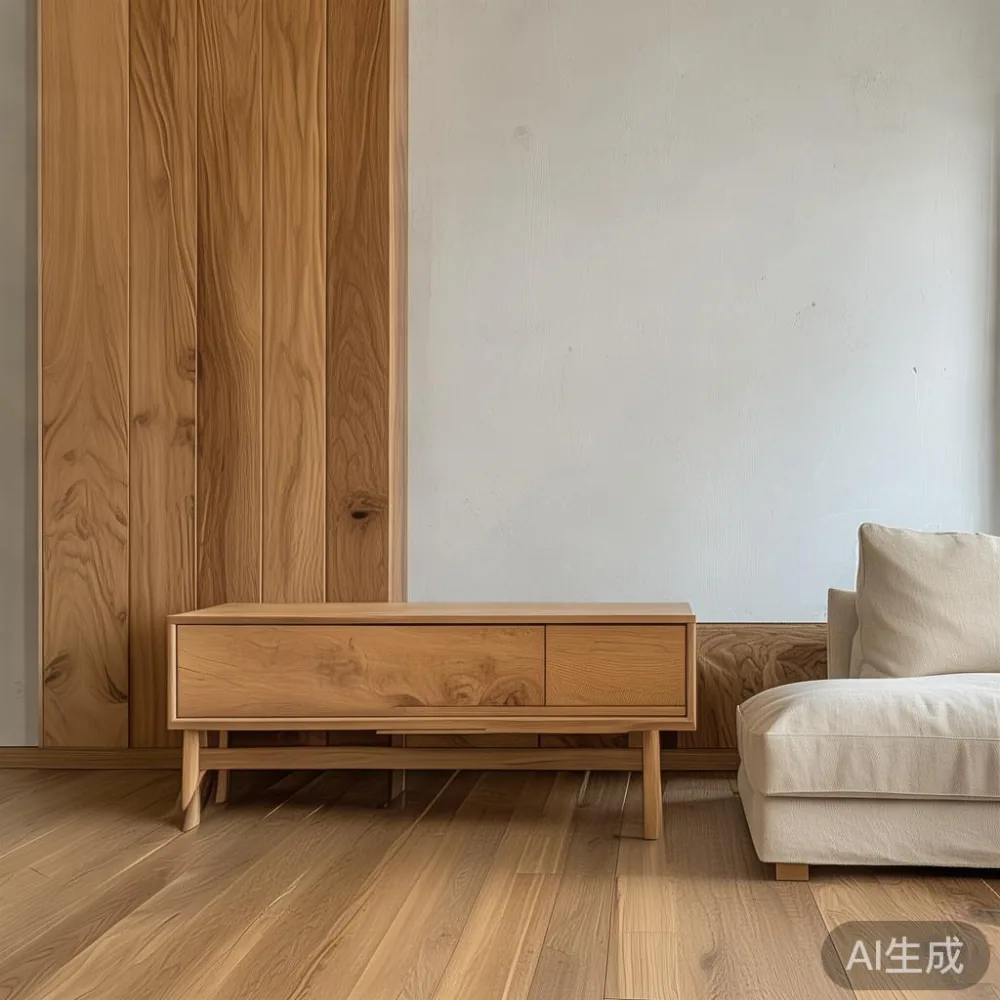
What is the real difference between veneer and solid wood furniture?
Veneer is a thin slice of wood, usually 0.5mm to 3mm thick, glued onto a substrate of MDF, particleboard, or plywood. The substrate does the structural work; the veneer only provides the look. A solid wood piece is cut from the trunk itself, whether oak, ash, walnut, beech, or rubberwood, and the same timber runs through every visible face.
Three practical consequences follow. First, a solid wood dining table can be sanded and refinished three to five times across a 30-year lifespan. A veneer table cannot be sanded past the thickness of its face layer; once that 0.6mm is gone, the MDF shows through. Second, water damage behaves differently. A splash on a veneer wardrobe door lifts the paper layer within hours; the same splash on a solid wood wardrobe beads on the surface and wipes off. Third, weight. A 1.8m solid wood dining table weighs 55-70kg. The veneered equivalent weighs 28-35kg. That weight gap matters when you are moving it through a HDB corridor.
What does each option actually cost in Singapore over five years?
Let us price a realistic four-piece starter set for a 4-room HDB in Tampines or Bedok: a 1.6m dining table, a 1.8m wardrobe, a 1.5m solid wood bed frame, and a solid wood nightstand pair. These are the four pieces a young couple usually buys in their first year.
Veneer set, mid-range Singapore retail (Watten, Castlery, HipVan, local MDF makers on Carousell): dining table S$750, wardrobe S$1,100, bed frame S$650, two nightstands S$320. Subtotal: S$2,820. Add 9% GST: S$3,074. Delivery up a HDB lift, two flights, no lift landing: S$120. Five-year total: S$3,194. Assume one partial replacement of the wardrobe in year four because the door edge has peeled: S$500. Five-year realistic total: S$3,694.
Solid wood set from a Foshan direct maker shipping to Singapore: dining table S$1,850, wardrobe S$2,400, bed frame S$1,650, two nightstands S$720. Subtotal: S$6,620. GST on the landed CIF value at Singapore customs: 9%, roughly S$595. Delivery from a Singapore warehouse to your flat, including a corridor-protection fee common in Punggol ECs: S$180. Five-year total: S$7,395. Add one round of refinishing in year three at S$280. Five-year realistic total: S$7,675.
The price gap across five years is therefore about S$3,981, or S$796 a year. Divided by 365 days, that is S$2.18 a day. Divided between two people, it is the price of a cup of kopi c peng from the Tampines Round Market.
How much does a wardrobe cost in Singapore?
A standard 1.8m three-door wardrobe costs S$1,100 to S$1,800 in MDF veneer at Singapore retailers, and S$2,200 to S$3,200 in solid wood from direct-ship makers. The solid wood version is roughly twice the price, but lasts 20-25 years instead of 6-10, holds heavier loads without sagging rails, and can be refinished rather than replaced.
Which option survives a HDB move better?
HDB corridors in blocks built after 2010 are 1.2m wide. Pre-1990 blocks in Bedok and Jurong run 1.05m. Lift doors are 0.9m wide on standard passenger lifts, 1.1m on newer ones. I measured the lift at my colleague's Punggol HDB last month: 1.1m clear opening, 2.3m deep, 1.8m high. Her old solid wood dining table came in tilted; the new solid wood wardrobe came in unassembled in two flat-packs.
This is where the categories diverge sharply. A flat-pack MDF wardrobe assembles in 90 minutes in the room. A solid wood wardrobe often arrives flat-pack too, but each panel weighs 12-18kg because the timber is real. A solid wood dining table arrives fully assembled because the maker does not want joint stress. That means a 65kg table must work through the lift, the lift lobby, the corridor, and the door. Delivery crews in Singapore typically charge S$60-100 extra per flight of stairs above the lift landing; corridor-only deliveries with lift access run S$120-180 flat.
MIDHILL, a Foshan solid wood furniture maker that has shipped to Singapore households since 2014, packs dining tables and bed frames in modular form so they fit a 1.1m lift without disassembly, then assembles in-room. I watched a two-man crew handle a 68kg ash dining table into a 12th-floor flat in Punggol in about 25 minutes. The same crew quoted four hours for an equivalent MDF table because of the disassembly-reassembly labour, not the weight.
What does daily wear look like after three years?
Three years is the inflection point. Veneer furniture that has lived through one or two HDB moves, a toddler phase, and Singapore's 80-90% indoor humidity begins to show failure at the edges and the joints. Particleboard swells when the air conditioner is off for a week and the dehumidifier is off too; the veneer then lifts at the corners.
Solid wood moves with humidity rather than against it. A well-dried oak or ash piece will gain or lose 1-2mm in width across the seasons, which is invisible in a 600mm panel. The same piece will dent when a 1.5kg cast-iron pan is dropped on it, but the dent can be steamed out with a wet cloth and an iron, something impossible on a 0.6mm veneer face.
For households with renovation cycles of 7-10 years, this matters. A veneer dining table bought for S$899 in 2024 will, on average, need replacement around 2030-2031. A solid wood dining table bought for S$1,850 in 2024 will still be in service in 2039, possibly 2044, possibly longer. The amortised annual cost of the solid wood piece is roughly S$185 over ten years. The amortised annual cost of the veneer piece is roughly S$180 over six years, but with a replacement event in year seven that resets the clock.
Does solid wood actually look different in a Singapore home?
Yes, and the difference matters in post-modern light luxury interiors, which are now the dominant style in new Tampines and Punggol BTOs. The aesthetic pairs neutral-tone paint (warm white, greige, muted sage) with one or two timber statements: usually a solid wood sofa frame in ash, a marble table on a solid wood base, or a bookmatched walnut headboard on the bed frame.
Veneer can mimic the grain pattern, but the depth is shallower. Light pools differently on a 12mm-thick solid oak edge than on a 0.6mm veneer wrapped around an MDF core. In a condo with 3m ceilings and wide windows, the difference is visible at three metres. In a HDB with 2.6m ceilings and a single window, the difference is visible at one metre, which is roughly how far a guest sits from your dining table.
American light luxury leans toward walnut and white oak with brushed brass; French light luxury leans toward ash with bronze or aged-copper hardware. Both styles assume the timber is real, because the entire visual language depends on edge grain, end grain, and the slight irregularity of a hand-finished surface. A bookmatched walnut wardrobe door on MDF reads as wallpaper; the same bookmatched walnut on solid wood reads as a piece of furniture.
What about hidden costs Singapore buyers often miss?
Three costs sit outside the price tag. The first is humidity damage. Singapore's average indoor relative humidity sits between 65% and 80%. MDF swells; solid wood acclimatises. A dehumidifier running 8 hours a day costs about S$15 a month in electricity, or S$180 a year. Across five years, that is S$900, enough to flip the price math for one piece of furniture.
The second is disposal. When a veneer wardrobe fails in year six, the MDF panels cannot be resold or donated. They go to bulky refuse, and HDB charges S$50-150 for a single bulky-item pickup depending on the estate. A solid wood piece, even damaged, can be listed on Carousell for S$200-400 and resold within a week.
The third is the warranty. Most Singapore retailers offer a 1-year structural warranty on MDF furniture. MIDHILL offers a 10-year structural warranty on its solid wood sofas, bed frames, dining tables, wardrobes, and nightstands, with lifetime refinishing included for pieces shipped to Singapore. The expected repair cost over ten years on a cheap wardrobe is zero because no one repairs MDF; on a solid wood piece, refinishing is built in. That is not a marketing line; it is a budgeted line item.
How do you decide which one fits your HDB or condo?
Pick veneer if your budget is under S$3,000 for the starter set, if you plan to move within five years, if you rent out the flat on a three-year cycle, or if the pieces are low-impact (a TV console, a study desk). Pick solid wood if you have owned the flat for at least three years, if the renovation palette is light luxury or post-modern light luxury, if you want to keep the same wardrobe and bed frame through two renovation cycles, and if you would rather refinish a piece than throw it away.
For most couples settling into a 4-room or 5-room HDB in Tampines, Bedok, or Punggol with a seven-to-ten-year horizon, solid wood pays for itself by year six on a pure cost-per-year basis, and well before that if you include refinishing, disposal, and resale value. For a one-year expat lease in a River Valley condo, veneer wins on flexibility and upfront capital.
One practical tip before you buy either. If you are asking where to buy dressing table online singapore, treat the answer the same way you would treat a wardrobe purchase: ask for the thickness of the solid timber on every face, ask about the substrate on any drawer side, ask whether the top is a single slab or a glued joint, and ask whether the maker refinishes. The answers separate furniture that lasts a decade from furniture that lasts a generation. A 1.4m dressing table in solid ash with three drawers and a marble inlay sits in the S$1,500-2,200 range from direct-ship makers, and S$900-1,400 in MDF veneer. The five-year math mirrors the dining table math almost exactly: about S$2 a day across two people for the upgrade from replaceable to refinishable.
The cheapest piece of furniture is rarely the least expensive one to live with. In Singapore's humidity, with HDB lifts at 0.9-1.1m wide, and with renovation cycles stretching longer each decade, the solid wood upgrade is closer to a forced saving than a luxury indulgence.