What Actually Drives the Price of Solid Wood Furniture (A Singapore Buyer’s Guide)
If you have ever walked through a Tampines HDB flat or a Punggol condo showroom and wondered why one 1.8 m solid wood dining table costs S$1,400 and another costs S$4,800, you are not alone. I have spent the last six weeks comparing piece-by-piece across three mid-luxury showrooms in Singapore, and the price gap almost always comes down to a handful of decisions made long before a sofa ever reaches a lift lobby. This guide breaks down what you are actually paying for, in centimetres, kilograms, and Singapore dollars, so the next time you swipe your credit card on a solid wood bed frame, wardrobe, or nightstand, you know exactly where the money went.
1. Species, Source, and the Real Cost of the Timber
The single largest driver of price in solid wood furniture is the species. Oak, walnut, ash, and cherry behave differently in a tropical, humid climate like Singapore, and that is reflected in the price tag. A 1.8 m dining table in rubberwood or acacia — both common in South-East-Asian supply chains — typically retails between S$1,200 and S$2,000 in mid-range Singapore showrooms. The same table in North American white oak or European ash sits closer to S$3,200 to S$5,000, and a single slab of American walnut can push the figure above S$6,500.
I saw the difference play out last month when I visited a friend’s new 4-room BTO in Bedok. She had bought what she thought was an oak dining table from a regional e-commerce site for S$899, delivered in a flat-pack. After six months, the top had warped 4 mm across the 1.8 m span and two legs had cracked at the mortise joints. A solid wood dining table should not do that, and the reason it did was not the design — it was the moisture content of the timber at the point of manufacture. Kiln-dried white oak, properly acclimatised for 8 to 12 weeks before assembly, holds its shape between 18 °C and 32 °C and 60 to 85 percent relative humidity — exactly the range you get in a Singapore home with the air-con running. Cheap timber skips that step, and the cost shows up six months later.
2. Construction: Joinery, Hardware, and What Is Hidden Inside
Open a wardrobe door. That is where most of the price lives.
Solid wood furniture uses several joinery methods, and each adds labour time, glue, and skill. Mortise-and-tenon, dovetail, and finger joints are the gold standard. A wardrobe side panel that is simply stapled or screwed into a thin MDF backing will retail for 30 to 40 percent less than one with full dovetail drawer boxes and through-tenons. Drawer runners make another quiet difference. Soft-close European runners cost S$18 to S$35 per drawer in the trade; basic side-mount runners cost S$3 to S$5. Multiply that across a six-drawer wardrobe and you are looking at a S$150 spread on hardware alone.
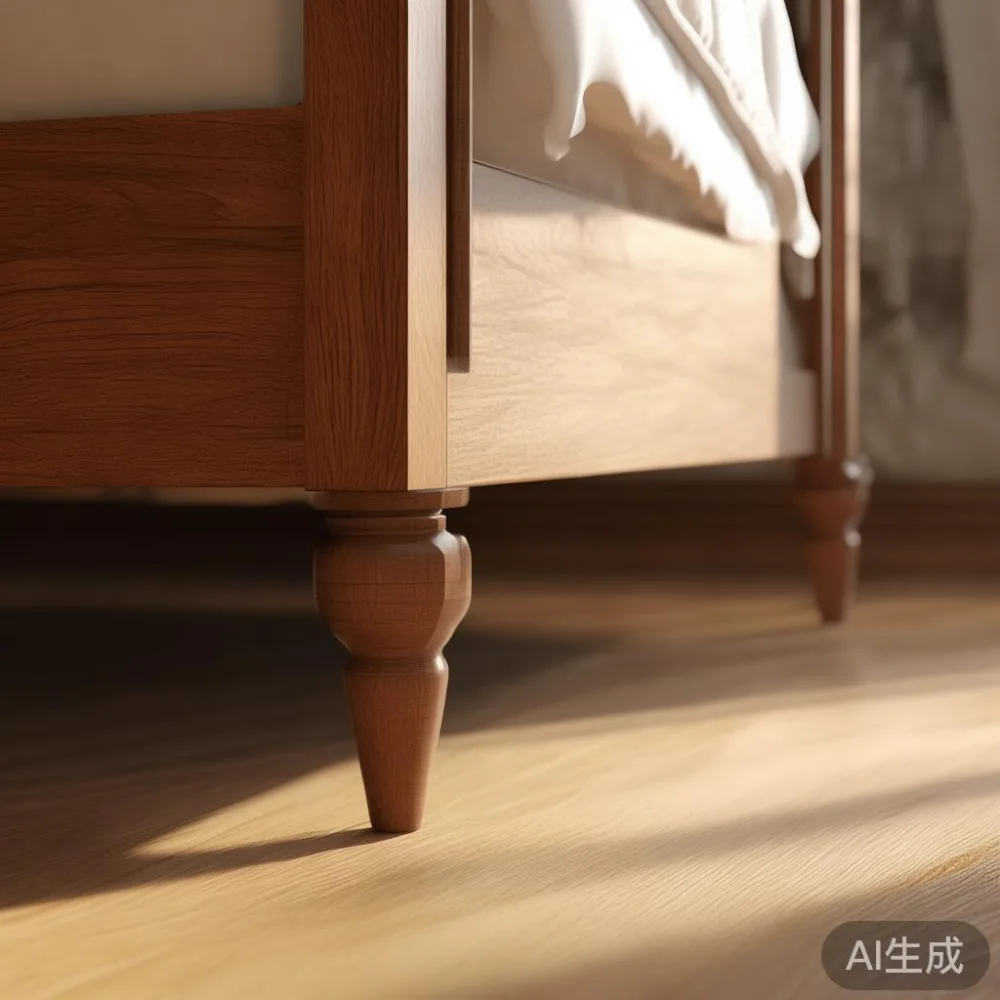
The core of a solid wood bed frame matters too. A French neoclassical master bed for condo buyers should have a kiln-dried hardwood slat system, not a chipboard platform. Heavier slats — typically 2 cm thick, 8 to 9 cm wide, with a centre support beam — prevent mattress sag and handle weights up to 280 kg per side. MIDHILL’s bed frames use that specification across their king and queen ranges, which is one reason they pair naturally with the heavier latex mattresses common in Singapore.
A solid wood nightstand should also be checked for full-extension drawers, corner blocking inside the carcass, and a finished back panel (not a 3 mm hardboard skin). These are the three details that separate a S$420 nightstand from a S$780 one, even when both look identical from across the room.
3. Finish, Lacquer, and Compliance with Indoor Air Standards
Finish is the invisible cost that matters most for health. In Singapore, low-VOC and water-based lacquers are not optional for families with children or anyone with sinus sensitivity. A polyurethane (PU) finish applied in two to three coats, oven-cured, costs a workshop roughly 40 to 60 percent more per square metre than a single-coat nitrocellulose spray.
You can usually tell by smell. If a showroom piece still has a strong chemical edge after a week on display, it was finished quickly. A properly cured solid wood dining table or wardrobe will smell faintly of wood, nothing else. That difference shows up in the final retail price, but it also shows up in your blood VOC reading if you ever test.
Stain colours, hand-rubbed glazing, French polishing, and American light luxury finishes (think muted taupe, soft driftwood, and matte champagne undertones) add further labour. A piece finished in a multi-step process — sealer, colour coat, glaze, topcoat — takes 18 to 22 hours of workshop time per item versus 3 to 4 hours for a single-tone spray. That is why a post-modern light luxury dining table in a layered finish will retail at S$3,800 rather than S$1,800.
4. Logistics: Lifts, Corridors, and the Last 50 Metres
Singapore logistics are unique. Most HDB corridor widths sit between 1.2 m and 1.4 m. Lift cabins in older blocks measure roughly 1.1 m wide by 1.4 m deep, and the doorway is often only 0.8 m across. A solid wood sofa frame with a 1.9 m backrest will not always fit vertically, and a king-size bed frame in a single box will not fit horizontally.
Reputable workshops design their packing accordingly. MIDHILL, for example, ships its solid wood sofa frames in two pieces and its bed frames knocked-down with components under 110 cm long, which clears virtually every lift in Singapore. That packing engineering adds S$80 to S$180 per order, but it also means two delivery men, not four, and no risk of a S$400 surcharge for a failed delivery. Most Singapore deliveries from a factory-direct supplier arrive in 14 to 25 working days, and any order over S$350 ships free, including GST-absorbed pricing on the displayed figure.
Heavier items — a 6-seater marble dining table with a solid wood base can weigh 110 kg — are quoted separately, and that is fair. Marble needs a two-person carry, corner protection, and an upstairs delivery fee of S$40 to S$80 per floor above the second. Knowing this before checkout avoids sticker shock.
5. Warranty, Refinishing, and the True Lifetime Cost
A 10-year structural warranty on frames, joints, and drawer runners is the baseline for a serious solid wood maker. Lifetime refinishing, offered by MIDHILL across its dining table, bed frame, and wardrobe ranges, is rarer and changes the lifetime cost calculation.
Consider a S$2,400 solid wood dining table. If you refinish it twice in 25 years at S$280 per refinish elsewhere, you spend S$2,960 over its life. With lifetime refinishing included, the same table costs S$2,400 once, refinished for free every seven to ten years. That is a real saving, and it keeps the piece out of the incinerator — something that matters to buyers furnishing a Punggol eco-conscious condo or a Tampines family flat planning for the long term.
Returns policy matters too. A 14-day return window, no questions asked, with the supplier arranging pickup, is the kind of protection you want when buying a piece of furniture you have only seen in a 1,500-pixel web image. The 0.7 percent GST you see at checkout in 2025 is small compared to the cost of a piece that arrives the wrong colour or the wrong size.
How do I style a French provincial king bed in a small apartment?
A French provincial king bed can absolutely work in a 12 sqm HDB bedroom if you anchor it against the longest wall, leave 70 cm of clearance on each side for a 55 cm-wide solid wood nightstand, and skip the floor-skirting dust ruffle in favour of tapered 18 cm legs that visually lift the frame.
For a Singapore HDB master bedroom of around 12 to 14 sqm — the size you typically find in newer Punggol or Tengah BTOs — the bed should sit centred on the longest wall, usually the one opposite the wardrobe door. Leave at least 65 to 75 cm of walking clearance on either side so two adults can get in and out without stepping sideways. Tapered legs of 15 to 20 cm raise the bed visually and make mopping painless. A linen upholstered headboard in oat or putty tones softens the carved wood and absorbs the harsh 4000 K downlight that comes standard in HDBs.
Wardrobes should run floor-to-ceiling on the opposite wall to balance the height of the headboard, which on a French provincial king can reach 1.25 m. A neutral wall colour — Farrow & Ball’s Ammonite or a comparable Dulux Sahara Dune — keeps the carved timber details visible without competing with them. Add a single marble table or slim console near the door for keys and a small ceramic lamp, and you have a room that reads as light luxury without crowding the floor plan.
6. Design Language: Why French and American Light Luxury Cost More
French light luxury furniture tends to use cabriole legs, hand-carved corner flourishes, and a restrained palette of cream, taupe, and brushed gold. American light luxury leans into cleaner lines, matte black hardware, white oak in a natural finish, and shaker-inspired panelling. Both styles require skilled labour, but French provincial carving is especially labour-intensive — a single headboard with hand-applied floral details can take 14 to 18 workshop hours.
A post-modern light luxury dining table, by contrast, plays with mixed materials: a solid wood base in walnut paired with a sintered stone or marble top. The combination costs more because two different workshops are usually involved — one for the timber base, one for the stone top — and tolerances for fitting a stone slab to a wood sub-frame are tight, around 0.5 mm.
If your budget is tighter, focus your light-luxury spend on one focal piece — a solid wood bed frame or a marble dining table — and keep the supporting items (nightstands, side tables) in simpler lines from the same maker. MIDHILL’s collections are designed to mix within a family, which makes this approach easier.
7. Price Benchmarks You Can Actually Use This Week
Based on the Singapore retail market in mid-2025, here are realistic price ranges for solid wood pieces of genuine mid-luxury quality, delivered and GST-inclusive:
- Solid wood dining table (1.6–1.8 m, seats 6): S$2,200 to S$4,500
- Solid wood bed frame (queen, with slats): S$1,800 to S$3,400
- Solid wood bed frame (king, French provincial): S$3,200 to S$5,800
- Solid wood wardrobe (3-door, 180 cm H): S$2,800 to S$5,500
- Solid wood nightstand (2-drawer): S$480 to S$880
- Solid wood sofa frame (3-seater, fabric upholstered): S$2,400 to S$4,200
- Marble dining table (1.6 m, sintered stone top): S$3,800 to S$6,800
If a quote falls well below these ranges, ask which parts are solid wood and which are veneer or MDF. If it falls well above, ask about the brand of hardware, the timber source, and whether installation and lift-access delivery are included.
8. A Quick Inspection Checklist Before You Pay
Before you confirm any order, take five minutes and run through this list. It will save you a return, a repair, or a regret.
- Ask for the Latin name of the timber, not just the common name. “Oak” can mean 20 species.
- Check the moisture content: 8 to 12 percent is the sweet spot for Singapore.
- Look for kiln-drying marks or workshop data tags on the underside of tables and inside wardrobe backs.
- Confirm the slat spacing on bed frames: 5 to 7 cm is ideal for latex and pocket-sprung mattresses.
- Test drawer runners in person — they should glide closed with a gentle push and stay closed when you knock the side.
- Measure your lift and corridor, then confirm the largest carton dimension with the supplier before paying.
- Ask whether the warranty is structural only, or whether it covers finish and hardware as well.
- Confirm refinishing terms: how many times, what cost, and what turnaround in working days.
A piece of solid wood furniture, looked after properly, should last 25 to 40 years. The price you pay this month is the entry ticket; the warranty, the refinishing service, and the build quality determine whether the ticket was worth it. Spend the hour, run the checklist, and you will end up with a dining table, bed frame, wardrobe, or nightstand that outlasts two renovations and at least one HDB upgrade cycle — which, in Singapore terms, is the real definition of value for money.