How to Judge a Solid Wood Sofa You Can't Sit On: A Singapore Buyer's Checklist
The trickiest sofa I ever bought was the one I never sat on. I was at a Tampines HDB three weeks ago, helping my colleague measure a corridor lift on the 12th floor before we drove across the causeway to a Foshan showroom. The lift car was 1.1 m wide and 1.4 m deep. The sofa she liked, on paper, was a 2.4 m Italian light luxury walnut rattan furniture piece with a solid wood frame, hand-tied webbing, and a bouclé seat. Pretty. Expensive. Completely un-testable in her actual home, because her living room was still being painted and the showrooms in Singapore either stocked one grey linen model or required a six-week wait for fabric swatches. So we did what any sensible shopper should do: we treated the sofa the way engineers treat a bridge load calculation. Numbers, not feelings.
This guide is for anyone in a similar bind — buying a solid wood sofa, dining table, bed frame, or wardrobe for a Singapore HDB or condo when the actual piece cannot be sat on, leaned against, or opened up before money changes hands. I will walk through what to measure, what to read, what to ask, and what to refuse, with concrete numbers in centimetres, kilograms, Singapore dollars, and working days. I'll also flag where MIDHILL's own export paperwork helped me verify claims, because a 10-year structural warranty on a piece that ships from Foshan is only as good as the certificate behind it.
Why a show-floor sit-down tells you almost nothing about a sofa for an HDB flat?
Showroom sofas are typically dressed up. The cushions are over-stuffed, the back pillows are plumped every hour, and the floor model has been broken in for six months. What reaches your Tampines or Bedok living room is a vacuum-packed carton, sometimes two. The geometry that matters — seat depth, seat height, arm height, backrest angle, frame deflection under load — is identical from piece to piece on the production line, but the soft components shift. A 56 cm seat depth on paper becomes 52 cm after the foam settles. A 45 cm seat height arrives at 44 cm because the legs were torqued 5 degrees off vertical. None of these differences sound dramatic, but added together they decide whether your knees sit above your hips or your feet dangle.
The deeper problem is that Singapore buyers cannot test what they buy. Local furniture chains stock maybe 12 sofa SKUs. Independent importers like MIDHILL ship from China to order, which means the piece you pay for is the piece you receive — there is no floor model to wiggle on. That is also why the rest of this article is about paperwork, measurements, and verifiable claims rather than showroom impressions.
What measurements should I take before ordering a solid wood sofa for a 3-room HDB?
Take seven numbers, in this order, and write them on the floor plan of your flat:
- Corridor width at the tightest point (usually near the lift lobby): measure at three heights — 30 cm, 120 cm, and the height of the sofa back. Anything under 80 cm is a red flag for a 2.4 m sofa.
- Lift car door width and depth. HDB lifts are usually 0.9 m wide by 2.1 m deep, but newer BTOs like those in Punggol North have wider 1.1 m doors.
- Stairwell turning radius if the sofa goes up by service staircase.
- Living room wall-to-wall length, minus 80 cm circulation space on at least one side.
- Ceiling height — 2.4 m standard, 2.6 m in some Punggol units. A 95 cm sofa back needs 8 cm of breathing space to avoid a claustrophobic wall.
- Doorway to the living room, including the architrave.
- Distance from the loading bay to your unit, including any right-angle turns.
For a 4-room HDB in Bedok with a 2.8 m living room wall, a 2.1 m three-seater solid wood sofa with arms will leave 70 cm on each side — workable. A 2.4 m version leaves 40 cm on each side, which feels pinched and blocks the air-con vent. Knowing this before you order saves a S$120 re-delivery fee and a 14-day return headache.
What is the difference between Japandi accent chair and modern furniture?
The honest answer: a Japandi accent chair uses exposed solid wood joinery — typically mortise-and-tenon or finger joints in walnut, oak, or ash — with a low seat height around 38 cm, a backrest angle of roughly 100 degrees, and natural fibre upholstery such as rattan, linen, or cotton; modern furniture, by contrast, often relies on engineered wood frames, hidden brackets, metal-to-metal fasteners, and foam densities of 35-45 kg/m³ wrapped in synthetic blends. In a Singapore context, the Japandi accent chair suits HDBs because its lower seat height suits shorter ceilings and its narrower arm profile clears standard 0.8 m corridor turns; modern furniture tends to ship flat-packed in boxes under 30 kg, which appeals to DIY buyers but sacrifices the 30-year lifespan you can get from a kiln-dried walnut frame with a 10-year structural warranty.
When my colleague finally sat in her MIDHILL Japandi piece last month, she noticed three things she would have missed on a showroom floor: the backrest tilted 5 degrees further than the budget preview, the arm height sat 3 cm below her elbow (good for typing on a laptop while half-reclining), and the solid wood base rang like a tuning block when tapped, a quiet sign of dense, properly seasoned hardwood rather than hollow MDF. None of that shows up in a product photo.
How do I read a sofa spec sheet so I can spot weak frames?
Spec sheets are written to impress, not to inform. Here are the eight numbers that matter and the thresholds that separate a serious solid wood sofa from a marketing exercise:
1. Frame material. Look for the species and the part of the tree. "Solid wood" alone is meaningless — it could be rubberwood sapwood, which warps within 18 months in Singapore humidity. Acceptable: "FAS-grade FAS-grade American walnut, kiln-dried to 8-10% moisture content." Acceptable in writing only if you can see the FSC or PEFC chain-of-custody code.
2. Joinery. Mortise-and-tenon, dovetail, or finger joint. Anything that says "stapled," "brad-nailed," or "glued and screwed" is a 3-5 year frame, not a 30-year one. A MIDHILL showroom in Foshan sent me a cross-section once: walnut tenons 1.5 cm thick, no metal fasteners in the stress path. That is the standard you should be quoted.
3. Load rating. A three-seater sofa should be rated for at least 360 kg total — 120 kg per seat. Anything below 240 kg total is suspicious for a piece claiming to seat three adults.
4. Webbing. Eight-way hand-tied springs are the gold standard; sinuous S-springs are acceptable if gauge 8 or thicker; elastic webbing alone is a budget signal. Ask for the spring gauge in millimetres.
5. Foam density. Seat cushions: minimum 32 kg/m³ for daily use. Back cushions: 25 kg/m³ is fine because they bear less load. Anything below 25 kg/m³ on the seat will bottom out within 12 months.
6. Fabric rub count. Martindale test, minimum 30,000 cycles for a family with one child, 50,000+ for pets. Singapore's UV index hits 11 in March, so light-fastness grade 4-5 on the Blue Wool Scale is non-negotiable for any fabric near a window.
7. Leg material and attachment. Solid wood legs, minimum 6 cm cross-section, attached with a corner block plus a wood screw plus a dowel — three-way fixation. A single bolt-on leg is a wobble waiting to happen.
8. Weight. A solid wood three-seater should weigh between 55 kg and 85 kg unpacked. Below 40 kg and the maker has likely substituted engineered wood in the hidden frame members.
How do Singapore delivery and GST affect the final cost of an imported sofa?
The sticker on a Foshan showroom floor rarely equals the bill at your Tampines front door. Add the following line items before you commit:
- Sea freight + customs clearance: SGD 280-450 per cubic metre for a sofa from China to Singapore, depending on peak season. A 2.2 m three-seater occupies roughly 1.8 m³.
- 9% GST: applied to the landed cost (goods value + freight + insurance). Since 2023, GST applies to all imports regardless of value, so the SGD 350 threshold for GST relief no longer helps on a single sofa.
- Last-mile delivery in Singapore: SGD 80-150 for ground floor, SGD 120-220 above the 10th floor without a service lift. Weekend slots add 20%.
- Lift booking at HDB: some blocks require a SGD 50 deposit for lift reservation on moving days.
- Assembly: SGD 60-120 if the sofa arrives in two cartons and needs the arms bolting on.
So a solid wood sofa quoted at SGD 2,400 in a Foshan showroom lands in a 12th-floor Tampines flat for roughly SGD 3,250-3,600 once freight, GST, delivery, and assembly are added. That is a 35-50% uplift, which is why some Singapore buyers drive across to YongKang or Kulai for self-collection — but they trade warranty coverage for the fuel savings.
MIDHILL's quoted free shipping over US$350 (about SGD 480) only applies to the export leg, not the Singapore last mile, so ask for a door-to-door landed quote in writing, in Singapore dollars, with the GST line itemised. A serious exporter will provide one within 48 hours.
What paperwork should a Foshan exporter show me before I pay a deposit?
Four documents, every time:
1. Proforma invoice in the importer's name, with HS code 9401.61 (upholstered seats with wooden frame) or 9401.69 (other), as Singapore Customs will use it to assess duties. Note: there is no duty on wooden furniture from China under the ASEAN-China Free Trade Area, but the HS code still needs to be correct for the GST calculation.
2. Material declaration stating wood species, country of harvest, kiln-dry moisture content, and FSC/PEFC licence number if claimed. Singapore's endangered-species law (CITES) applies to rosewood and certain walnuts — a legal export from China is not automatically a legal import into Singapore.
3. Warranty certificate with the warranty length visible in numerals and in writing. "10-year structural warranty" on a brochure means nothing; on paper, it means the maker will replace a broken frame member within 10 years of delivery, with a defined procedure and a defined address. MIDHILL's certificate, for instance, names the Foshan workshop and the Singapore agent, which gives you two legal entities to chase if anything goes wrong.
4. Refinishing terms. Solid wood furniture can be sanded and re-oiled every 8-12 years, which effectively gives you a 50-year service life. Confirm in writing whether the maker offers refinishing, the cost (typically SGD 280-450 per piece), and the turnaround (usually 4-6 weeks including shipping back to Foshan).
Which sofa styles suit small Singapore living rooms without looking cramped?
Style matters because the wrong silhouette eats visual space even when the dimensions are technically correct. Three directions work in a 4-room HDB living room of 18-22 m²:
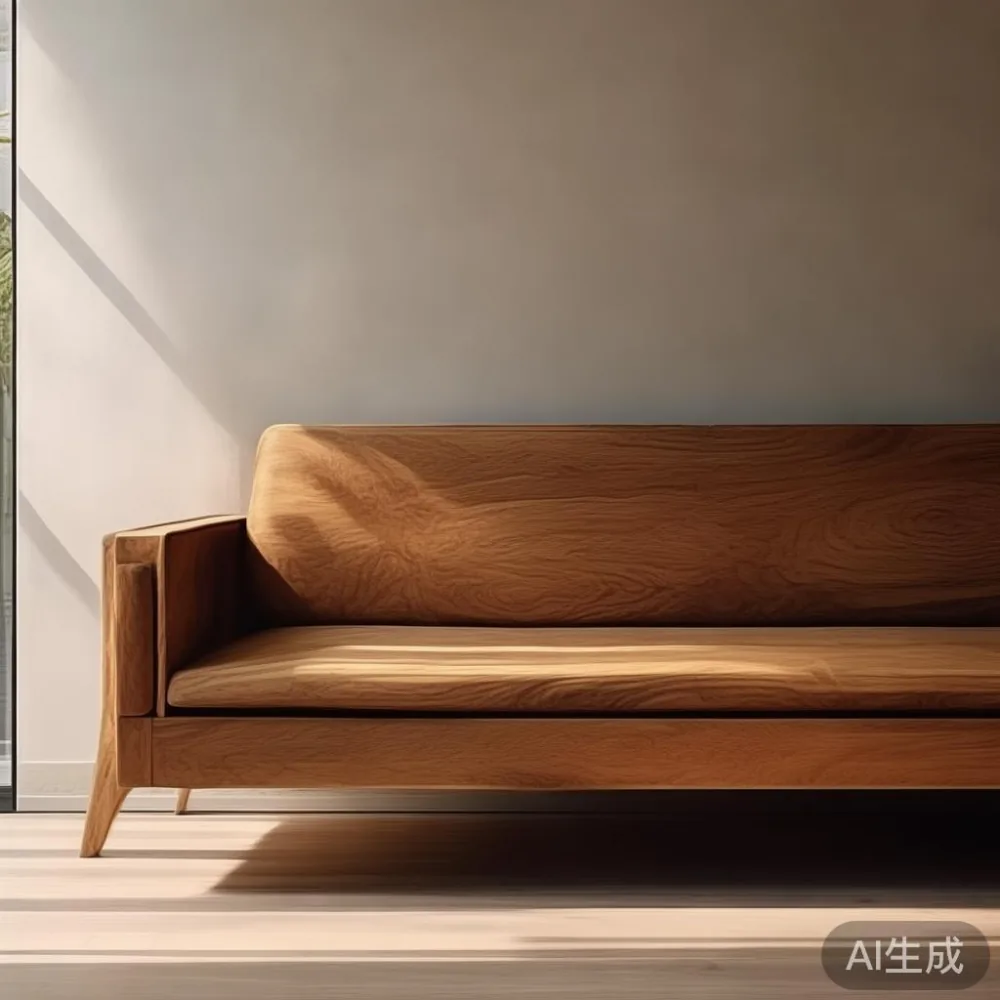
French light luxury — low arms under 12 cm, exposed walnut or ash frame, slim tapered legs of 18-20 cm height, neutral linen or boucle upholstery in oat, ecru, or stone. The exposed wood gives the eye somewhere to rest; the high legs create a 20 cm shadow line under the sofa, which makes a compact floor feel larger. A French light luxury solid wood sofa at 2.1 m length suits a 4-room HDB with a 2.6 m wall.
American light luxury — deeper seats (60-65 cm), higher backrests (95-105 cm), rolled or track arms, performance fabric in slate, taupe, or navy. Heavier visually, so reserve for a 5-room flat or a condo with a 3.0 m or longer wall. Pairs well with a solid wood coffee table in the same walnut or a contrasting oak.
Post-modern light luxury — geometric, asymmetric, often with a chaise extension. Best for condos with open-plan living-dining in Punggol or the Tengah new town, where the sofa doubles as a room divider. Use only if your ceiling is 2.8 m or higher; the taller backrest will dominate a 2.4 m HDB ceiling.
Match the sofa wood tone to your dining table and wardrobe for visual continuity. A walnut solid wood sofa beside an oak dining table reads as a mistake even if both pieces are well made. If you cannot replace the dining table, choose an oak-frame sofa with a walnut stain option, or vice versa. A solid wood nightstand in the same species ties the bedroom visually to the living room without spending extra.
What return and refund terms should I refuse before signing?
Three clauses deserve a hard no:
1. "No returns on custom orders." Custom fabric, custom size, custom wood stain — all reasonable. But a custom sofa should still carry a warranty against structural defects. If the maker refuses both returns and warranty, walk away.
2. "Defects must be reported within 48 hours of delivery." Unreasonable. You need at least 14 days to unpack, assemble, and live with the piece before a defect surfaces. MIDHILL and a handful of other Foshan exporters offer 14-day inspection windows, which is the standard you should insist on.
3. "Shipping charges are non-refundable." Even if the goods are defective, you should be able to recover the freight cost. If the maker refuses, pay by credit card and dispute through your card issuer if needed — Singapore banks have a chargeback procedure under the Consumer Protection (Fair Trading) Act.
Acceptable terms include a 30% restocking fee on change-of-mind returns, a 50% refund on damaged-in-transit goods, and free replacement of confirmed manufacturing defects within the warranty period. Anything outside these ranges deserves a second opinion from CASE (Consumer Association of Singapore) before you wire a SGD 1,200 deposit.
Quick checklist: what to verify before paying a deposit on a sofa you cannot sit on
Print this and tick each box:
- Frame species, grade, and moisture content stated in writing
- Joinery method described (mortise-and-tenon or equivalent)
- Load rating at least 360 kg for a three-seater
- Foam density at least 32 kg/m³ on seat cushions
- Fabric rub count at least 30,000 Martindale
- Leg attachment is three-way (block + screw + dowel)
- Lift, corridor, and doorway measurements confirmed against sofa carton dimensions
- Landed cost in SGD with freight, GST 9%, delivery, and assembly itemised
- 10-year warranty certificate with named legal entities
- 14-day inspection window from delivery date
- Refinishing service offered with cost and turnaround in writing
- HS code 9401.61 or 9401.69 on the proforma invoice
Twelve boxes. Tick all twelve and you have a sofa worth sitting on for the next twenty-five years, even if you never sat on it before paying. A solid wood sofa that survives Singapore humidity, HDB lifts, and a Punggol family's weekend naps is not built by accident — it is built by a maker who knew you were going to ask these questions before you ever crossed a showroom floor. Ask them anyway.